
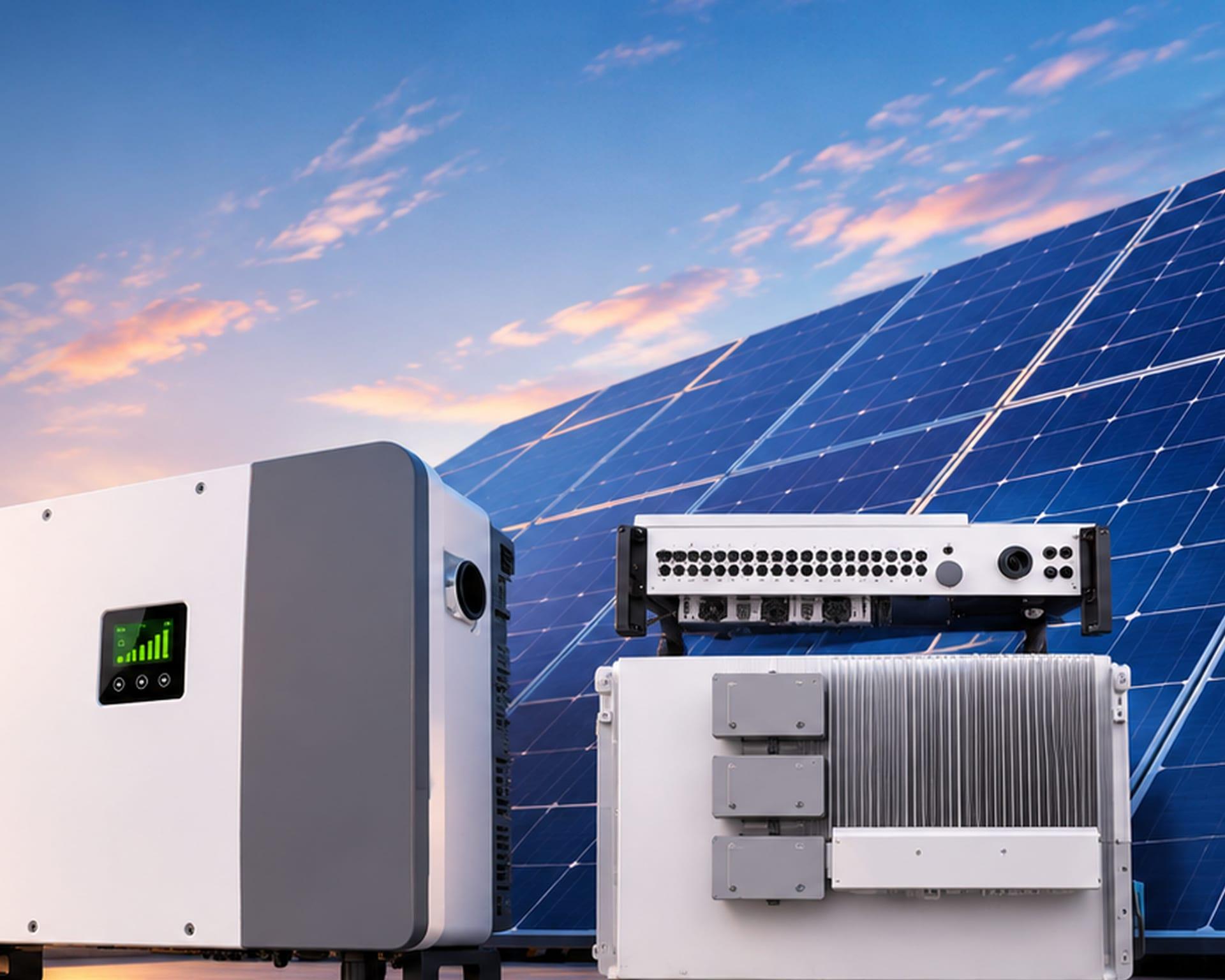
A solar inverter size calculation is often reduced to a single ratio: divide the array wattage by a number and pick the next size up. That shortcut ignores the two things that actually constrain an inverter — the load it must serve and the DC operating window of its MPPT inputs. A method that starts with those constraints produces a defensible shortlist; a ratio alone produces a guess.
This article is a design-review aid, not a quotation, a performance prediction or a stamped electrical design. Namma Power handles component-focused selection for retail, bulk and OEM sourcing and pan-India C&I enquiries. Detailed engineering, protection studies, approvals and commissioning are confirmed project by project with qualified engineers.
A solar inverter size calculation starts with the load, not the panel count
The inverter's AC rating must be able to supply the loads it will actually see. Begin with a load list:
- Continuous loads that run for long periods, such as pumps, refrigeration or IT equipment.
- Peak or starting loads with high inrush, such as motors and compressors.
- Simultaneity — not every load runs at full power at the same time.
- Future loads that are reasonably foreseeable, so the unit is not undersized on day one.
A system designed purely around the array can end up with an inverter that cannot carry the site's peak demand, or one that is far larger than the loads require. Both are costly mistakes, in different ways.
Understand the DC/AC ratio
The DC/AC ratio is the rated DC array power divided by the inverter's AC power rating. A ratio above 1 means the array's nameplate DC power exceeds the inverter's AC output. This is common and can be reasonable: modules rarely produce their nameplate rating in real conditions, so a modestly oversized array can improve early-morning, late-afternoon and cloudy-day output. The trade-off is clipping — at times of high irradiance, the inverter limits output and some potential energy is discarded.
There is no universal correct ratio. The right value depends on the site's irradiation profile, the load shape, the array orientation and the cost of the inverter relative to modules. Treat any ratio quoted as a rule of thumb as a starting hypothesis to test, not a conclusion.
The MPPT voltage window is a hard constraint
An inverter's maximum power point tracker operates only within a specified voltage range, and the unit has absolute maximum DC voltage and current ratings that must never be exceeded. String length is therefore bounded at both ends:
- Cold condition: module open-circuit voltage rises as temperature falls. Using the datasheet temperature coefficient, confirm the corrected string voltage stays below the inverter's maximum DC input on the coldest design day. This is a safety limit.
- Hot condition: module maximum-power voltage falls as temperature rises. Confirm the corrected value stays above the inverter's minimum MPPT voltage on the hottest expected operating day. Below that point, tracking degrades.
Parallel strings add current, so the total must stay within the inverter's DC input and short-circuit current ratings. Orientations and shading zones should be allocated to separate MPPTs where possible. Those limits should appear explicitly in the design documents you receive.
Efficiency, thermal behaviour and battery interface
Two further checks refine the shortlist. First, compare weighted efficiency (measured across a range of operating points) rather than a single peak figure, and review the derating curve — inverters reduce output when internal temperature rises, so enclosure and ventilation are part of the sizing question. Second, if the system includes storage, the inverter's battery interface, supported chemistry, voltage range and BMS communication protocol must be compatible with the proposed battery.
A worked example — illustrative assumptions, not a quotation
The figures below demonstrate the method only. They are not a recommendation, a performance guarantee or an offer, and they do not account for tariffs, savings or site-specific approvals.
Assumptions: a home with a single, unshaded roof plane; a proposed 6 kWp DC array; a maximum simultaneous load of 3.5 kW; a hot climate with mild winters; no battery in this example.
| Step | Illustrative input | Check |
|---|---|---|
| Load ceiling | 3.5 kW simultaneous | Inverter AC rating must meet this with margin |
| Array | 6 kWp DC | Candidate AC rating around 5 kW gives a DC/AC ratio near 1.2 |
| Cold string check | Temperature-corrected Voc | Must stay below inverter maximum DC voltage |
| Hot string check | Temperature-corrected Vmp | Must stay above minimum MPPT voltage |
| Current check | Parallel strings × module current | Must stay within DC input and short-circuit ratings |
| Thermal check | Site ambient and enclosure | Review derating curve at expected operating temperature |
Under these assumptions, a 5 kW-class unit would be a reasonable candidate to investigate further. If the roof had three orientations and heavy afternoon shade, the same array might instead point towards a design with more MPPTs or module-level electronics. The method is unchanged; only the inputs differ.
A sizing checklist
- List continuous, peak and foreseeable future loads.
- Fix the array size and record the exact module datasheet values.
- Check cold-condition open-circuit voltage against the maximum DC rating.
- Check hot-condition maximum-power voltage against the MPPT window.
- Sum parallel-string current against input and short-circuit ratings.
- Allocate orientations and shade zones to separate MPPTs.
- Compare weighted efficiency and derating behaviour, not peak efficiency.
- Confirm battery compatibility if storage is included.
Relevant reference points include BIS (accessed 20 Nov 2026) for Indian PV and inverter standards, IEC 62116 (accessed 20 Nov 2026) for islanding-prevention testing, IEC 61683 (accessed 20 Nov 2026) for power-conditioner efficiency measurement and NREL (accessed 20 Nov 2026) for general photovoltaic context. Verify the current official text and the requirements that apply at the site.
Questions to ask a supplier
- Which exact inverter model and variant is quoted, and what are its AC rating, MPPT window and maximum DC ratings?
- How was string length checked at the coldest and hottest design temperatures?
- What DC/AC ratio is proposed, and how much clipping is predicted at this site?
- What are the weighted efficiency and the derating curve for this unit?
- If storage is included, which battery models and communication protocols are supported?
Related reading
For a site-specific scope, use Request a Project Quote.